Basics


Info Download

Advanced

v/v
V
V

Plot Download

Architecture here is conversational: baroque flourishes whisper to austere functionalism, while graffiti tags answer in bright, impatient scrawl. Shopfronts glow—antique clocks, rows of amber bottles, a neon sign buzzing lightly in Czech—each storefront a micro-theater. Scent is a constant narrator: roasted coffee, sweet chimney cakes, diesel and damp stone after rain.

Language overlays the soundscape — Czech consonants clipped and affectionate — blending with snippets of other tongues. A street musician tunes a violin into something both mournful and buoyant; coins clatter like punctuation. Dogs, indifferent to history, inspect lampposts as if reading the city’s small print.

At number 145, perhaps a doorway opens into a courtyard where ivy climbs a brick wall and the air cools. A woman pours tea for two. On a bench, someone writes a postcard, unsure whether to describe the skyline or the small kindness witnessed that afternoon.

Czech Streets 145 threads the city’s pulse into a single, electric snapshot. It’s dusk: tram tracks glint like veins, cobbles still warm from daylight, and lanterns awaken one by one. The number — 145 — could be an address, a bus route, or simply a beat in a playlist for wandering; whatever it is, it gives the scene a frame.

Passersby move in layered rhythms. An old man in a wool cap pauses by a bakery window to choose a pastry with the care of ritual; a cyclist flashes past, earbuds in, counting seconds to a meeting; students spill from a tram, laughter ricocheting off plastered tenements. Above, laundry flutters like small flags marking lives in motion.
Disclaimer: This tool is provided for educational and illustrative purposes only. No guarantee is made regarding accuracy, suitability, or performance. Use at your own risk. - Copyright: ufelectronics.eu / Andreas Dyhrberg

×
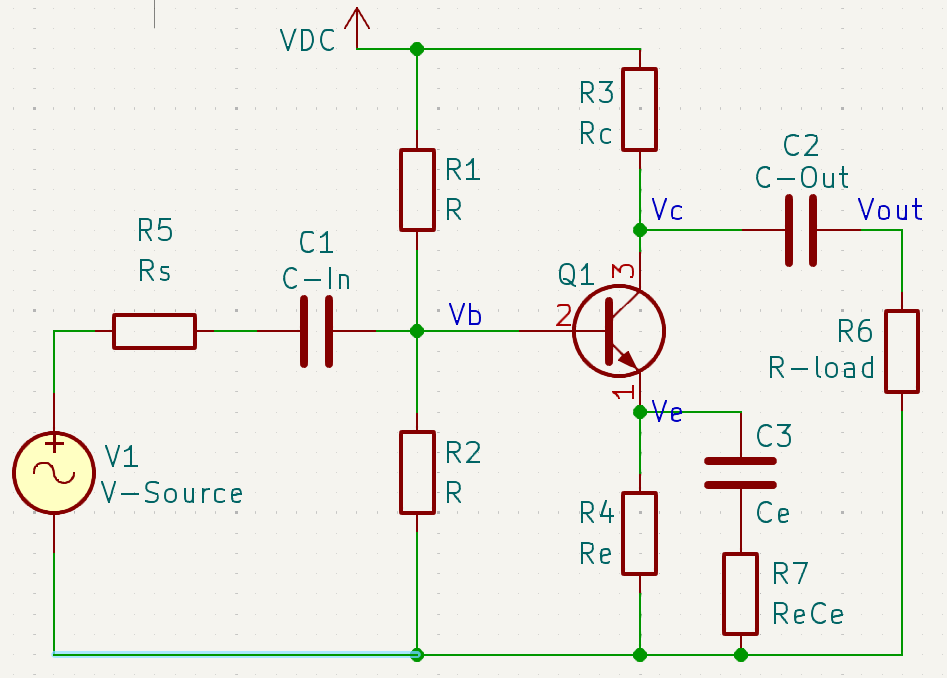
Amplifier Schematic
×

There are different ways to calculate an amplifier, depending on what you want to achieve.

Maybe you want to achieve a certain gain, as far as possible (classic mode). Or you have a low Vcc to respect (modern mode). Or you work with analog audio amps (symmetry mode).

Depending on what you want to achieve and the way of calculating it. Some fields might become dependent on others, or the other way around.

Your above choise makes some input fields available for manipulation, while hiding others.


🎯 1. Target Gain (Av) — "Classic mode" czech streets 145 best

You care about how much your amplifier multiplies the input signal.

Set desired voltage gain and Rc voltage drop. Best for learning and simple amplifiers.

You say: “I want a gain of 10.”
The app adjusts resistors to try and match that.
You must give Av and Vrc (the voltage dropped across Rc).

Best for common emitter amplifiers.

✅ Default choice for most beginners and educational use. At number 145, perhaps a doorway opens into


⚡ 2. Target Emitter Voltage (Ve) — "Modern mode"

You care about setting a healthy DC bias point.

Prioritize stable biasing via Ve. Useful for low-voltage circuits or precision designs.

You say: “I want Ve = 0.5 V, to keep the transistor out of trouble.”
This makes sure your transistor stays in active mode.
Gain becomes whatever it turns out to be.

Ideal for common emitter amplifiers when the goal is to ensure proper biasing for low-voltage or precision circuits, and it’s also used in class AB amplifiers to prevent distortion a cyclist flashes past

✅ Useful in low-voltage designs (e.g., 3.3V systems).


🧭 3. Target Collector Voltage (Vc) — "Symmetry mode"

You want to place the collector in the middle of the power rail.

Target Vc = Vcc/2 for maximum signal swing. Great for audio and analog signals.

You say: “Make Vc = Vcc/2” for maximum swing.
Useful for analog audio amps or symmetrical headroom.
Gain and Ve are outcomes.

Best for common collector amplifiers and class AB amplifiers.

✅ Best for signal integrity.

Czech Streets 145 Best [patched] Direct

Architecture here is conversational: baroque flourishes whisper to austere functionalism, while graffiti tags answer in bright, impatient scrawl. Shopfronts glow—antique clocks, rows of amber bottles, a neon sign buzzing lightly in Czech—each storefront a micro-theater. Scent is a constant narrator: roasted coffee, sweet chimney cakes, diesel and damp stone after rain.

Language overlays the soundscape — Czech consonants clipped and affectionate — blending with snippets of other tongues. A street musician tunes a violin into something both mournful and buoyant; coins clatter like punctuation. Dogs, indifferent to history, inspect lampposts as if reading the city’s small print.

At number 145, perhaps a doorway opens into a courtyard where ivy climbs a brick wall and the air cools. A woman pours tea for two. On a bench, someone writes a postcard, unsure whether to describe the skyline or the small kindness witnessed that afternoon.

Czech Streets 145 threads the city’s pulse into a single, electric snapshot. It’s dusk: tram tracks glint like veins, cobbles still warm from daylight, and lanterns awaken one by one. The number — 145 — could be an address, a bus route, or simply a beat in a playlist for wandering; whatever it is, it gives the scene a frame.

Passersby move in layered rhythms. An old man in a wool cap pauses by a bakery window to choose a pastry with the care of ritual; a cyclist flashes past, earbuds in, counting seconds to a meeting; students spill from a tram, laughter ricocheting off plastered tenements. Above, laundry flutters like small flags marking lives in motion.